
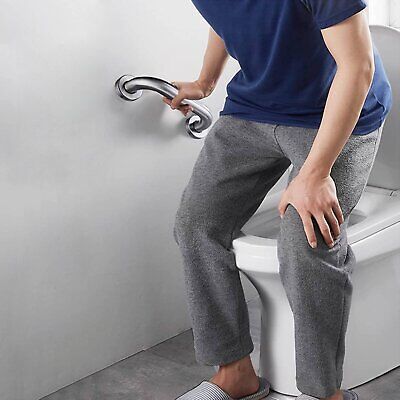
We spend roughly a third of our lives in bed. And for most of that time, we are not fully conscious, not fully coordinated, and operating in low or zero light. It is the one time of day when the human body is most physically vulnerable and also the time when most homes offer the least structural support. Bedside Rail are among the most under-installed safety products in the Indian home.
And the reasons are almost entirely about perception, the assumption that a bed safety rail belongs in a hospital or a care facility, not in a thoughtfully designed home.
At Artis Care, we built our Bedside Rail range to change that assumption entirely.
The Reality of Nighttime Falls
Bed falls are more common than most people acknowledge. They occur across age groups in children, in adults recovering from illness or surgery, and increasingly in elderly individuals whose spatial awareness and muscle response during sleep transitions are reduced.
The moments of highest risk are predictable: getting up during the night for a bathroom visit, rolling too close to the bed edge during deep sleep, or attempting to rise from bed in a semi-conscious state. These are not moments of recklessness. They are moments of ordinary human vulnerability.
For elderly users, a fall from bed can have consequences that extend far beyond the immediate injury. The resulting fear of falling, a well-documented psychological response, often leads to reduced mobility, increased dependence, and a measurable decline in quality of life. Bedside rail for elderly users address both the physical risk and this secondary psychological impact.
Who Benefits From Bedside Rail?
Elderly adults living independently represent the most significant user group for bed rails for the elderly. As balance, muscle strength, and spatial awareness reduce with age, the bed-to-standing transition becomes more physically demanding and less predictable. Bedside safety rails for adults give elderly users a fixed handhold at exactly the moment they need it; when they are sitting up from a lying position, shifting their weight to the edge, and preparing to stand.
Post-surgical patients recovering at home often find the bedroom transition surprisingly difficult. Knee replacements, hip surgeries, and abdominal procedures all affect the muscle groups most involved in getting out of bed. Bedside rails for post-surgery recovery allow patients to manage this independently, reducing their dependence on a caregiver for what should be a private moment.
Differently-abled users managing conditions that affect lower limb strength or coordination benefit from bed rails for the differently-abled as a consistent, reliable support point at the one place in the home they spend the most time.
Caregivers supporting any of the above users also benefit, not because the rail eliminates their role, but because it reduces the frequency of assistance required for routine movements, which reduces physical strain on both parties.
The Design Tension & and How Artist Care Resolves It
The traditional elderly bed rail is a product designed for function alone, and it shows. The visual language is clinical, the materials are utilitarian, and the presence in a bedroom communicates illness or incapacity rather than thoughtful home design.
This is a problem. A bedroom is one of the most personal spaces in a home. It should reflect the inhabitant’s taste, their comfort, and their sense of who they are. A product that visually signals fragility, however useful it may be, creates a subtle but real psychological burden for the user.
Artis Care’s bedside rail is built from SS 304 stainless steel with a finish and profile that integrate into a premium bedroom environment. The visual language is architectural, not medical. Installed beside a well-made bed, Artis Care Grab Rails read as a considered design choice, not a concession to physical limitation.
For families choosing bedside rail for elderly parents, this distinction matters enormously. A product that an elderly parent accepts and uses is infinitely more valuable than one that is avoided because it makes them feel diminished.
Adjustability and Fit: Getting the Configuration Right
Bedside support rails are not one-size-fits-all products. Bed heights vary. User heights and mobility profiles vary. The ideal configuration depends on where the user needs support or whether that is primarily during the sit-up phase, the pivot phase, or the stand phase of getting out of bed.
Artis Care’s bed assist rails are available in configurations that accommodate a range of bed heights and user needs. The positioning should allow the user to grip the rail comfortably while their elbow is at a slightly bent angle, giving them both leverage and control without overextending.
For home care bed rails, a professional assessment of the user’s specific mobility profile is recommended to ensure the rail is positioned at the most effective point.
The Difference Between Reactive and Proactive Safety
Most bedside rails are installed after a fall. After a parent is discharged from the hospital. After a frightening night. This is understandable. It takes a jarring event to shift priorities. But it also means the product is arriving too late to prevent the incident that prompted its purchase.
Proactive installation of fall prevention bed rails for elderly family members changes this equation. It means the rail is already part of the bedroom environment when it is needed. The user has already adjusted to its presence, developed the instinct to use it, and built the confidence that comes from knowing reliable support is there.
Bedside rails installed before they are urgently needed are exponentially more effective than those installed after.
A Home That Holds You Through Every Chapter
The best homes are not static. They evolve with the people who live in them through youth, through parenthood, through the decades of middle age, and through the later years where the body’s needs change in ways that deserve to be met, not masked.
Bedside rails are not a symbol of decline. They are a symbol of a home that is paying attention. A home that has been designed or adapted to support the full arc of the lives lived within it.
At Artis Care, that is precisely the kind of home we are in the business of helping you build.
Because safety, when it is done with intention and quality, is not the opposite of beautiful living. It is part of it.
